Background

October 6, 2011

I'll just sell it on Ebay

So, for some reason I decided to dive into the world of eBay selling recently. When I moved back in with my parents I cleaned out my room and came up with a bunch of collectible items that I didn't want to just throw out, so I decided to try to sell them. Then my mom came up with a box and my brother followed up with a box of stuff as well.

Why not? Make some extra cash and get rid of some clutter!

Ha. It's kind of a lot of work to sell something on eBay! Take a picture, write a detailed description, clean up item, research/decide on a price, determine shipping costs, open a paypal account, and post the item. *whew*

And of course I had no idea of all of the little charges that come along with posting something. Do you want to be listed in more than 1 category? That will be an extra 10 cents please. Want to list more than 7 days? That's an extra 20 cents. You want a gallery picture? Well, if you're not lucky and get a free promotional offer, that will be 20 cents. Oh and let's not even talk about the percent kick back you have to give back to eBay after you sell something.

I originally refused to give in to all of these nickle and dime charges to make my product look better. I'm supposed to be MAKING money on these items, not losing it! Not to mention that none of these collectibles are incredibly enticing or expensive. But now I'm rethinking that decision.... I had maybe 20 views total on my 16 items the first time.... and a few of those were my own mom!

My first round of listings had 16 items in it.... and 1 sold. ONE. It was a picture frame with Toto from Wizard of Oz on it. Talk about a ton of work for 12 bucks. I have since then relisted the other 15 items to try again.


I'm wondering... do you sell on eBay? What are your tricks? Do you shell out that 10 cents to have it pop up under more than 1 category? What do you do to make your "description" sound like something a person can't pass up?

And how in the heck do you figure out a shipping cost? That is taking me the most time, and quite frankly it is a pain! I have at least 15 other items that aren't listed because I can't figure out a cost effective way to ship them!

And finally, let me know if you happen to know anyone who is interested in Wizard of Oz collectibles, Peanuts collectibles, Pokemon cards, or Beanie Babies. I'm trying to find good homes and I promise the prices are not outrageous. :)

Help!

October 2, 2011

PINK

Not sure if you've seen my latest Foliage Friday post about a pink flowering tree or not....

But, I picked that tree because Stephanie asked to learn about "the tree that flowers pink in spring." I wasn't sure which one she was picturing in her mind, so I picked one to start! But then my mom suggested listing out a bunch of pink flowering trees that she could be thinking of since some people pick out trees because of how they flower! What a great idea....

Here are a few trees that Stephanie could have been picturing in her mind and would do resonably well in our zone and climate. See the redbud post below. That tree counts, too!

1. Saucer magnolia
There are a bunch of magnolia varieties and cultivars, but I chose the saucer magnolia because I know for a fact that it does well in our zone and I am sort of a fan. :)

Closer up of magnolia flowers

A little farther away of the magnolia
2. Crabapple
There are a bagizillion different kinds of cultivars of crabapple trees. I did a general search of pink flowering crabapples. These are pretty standard colors/shapes of flowers to get an idea!

Close up of crabapple flowers
I have no idea who that man is in the foreground!

3. Pink Kousa Dogwood
There are also a bunch of dogwood cultivars that flower pink, but I love the kousa and I believe it would do well in our area.


Close up of dogwood flowers
Farther away of the pink flowering dogwood tree
4. Kwanzan Cherry
I don't know too much about this cherry tree, but it is super pretty and I'm a fan of cherry trees, they are so pretty!

Close up of cherry flowers

Farther away of a cherry tree on a random slope
5. Pink Flowering Almond tree
I will admit, I know nothing about this tree. But I wanted 5 trees in this post and googled to try to find a 5th. I think this is really pretty!!!

Close up of almond flowers
Farther away of the almond tree. They have sort of a branchy shape, but still nice!


There you go!  A very pink-y post!!!

September 30, 2011

Foliage Friday - Eastern Redbud

Happy Foliage Friday! Holy cow, is it really Friday? And really the end of September? Time is flying! But luckily for you, something that always stays the same - is your Foliage Friday. :)

Ready for a Foliage Friday update? I hope so! Here is your friendly plant post, where I talk about a plant I love and hopefully convince you to either plant it or just be more knowledgeable about it.

Plant: Cercis canadensis, Eastern redbud

Eastern redbud flowering in spring

Why: Not sure if you read comments from other posts, but my lovely cousin, Stephanie, commented that she wanted to learn about "those pretty trees with pink flowers in the spring that I want." First of all, this made me giggle because there are a bunch of trees with pretty pink flowers in spring... and I can't remember which one she liked the most! So today I picked one of the pink flowering trees to see if I was right. If not, I'll try again until we find it. :) And of course, hugs to Stephanie for actually commenting/reading/and making a suggestion! Steph and my dad are the best for humoring me haha.

Landscape uses: I forgot to mention this before.... but I love this tree. Love. This. Tree. I'm not 100% sure why. I do remember that it was one of the first plants I learned about in my woody plant ID class. Maybe that was part of it!

Overall, the Eastern redbud gets between 15-30 feet tall and 25-30 feet wide when it reaches maturity. Yes, this is a little on the shorter side compared to some of the trees I have written about. This makes it a lovely ornamental tree for a lawn or need a building since it doesn't need a large amount of space for its crown or spread.

Eastern redbud in summer
Its leaves are heart shaped (vocabulary: cordate means heart shaped when referring to leaves.) and it has zig-zag-gy (I just made that word up) delicate branches as well. In spring and summer, the leaves are a common green and in fall are yellow.

Heart shaped leaves of the Eastern redbud
As you can imagine by the name, it flowers! But not red, it's more of a deep pink. The flowers bloom before the leaves open, so it makes a striking statement in spring. You'll see the flowers typically between March and May, depending on the weather and which zone you live in.

Close up of the pink flowers of the Eastern redbud
It does best in well drained, fertile soils and doesn't require a lot of watering once established. Prefers to be planted in full sun to partial shade. Keep an eye on the leaves scorching if the leaves are splashed with water during high peaks of sunshine.

Other uses: I didn't know this, but after reading a little bit, I learned that the flowers and flower buds can be added to salads, breads and even pancakes! They are very high in vitamin C. Who knew? The seed pods can also be eaten and prepared in a vareity of ways: raw, boiled, sauteed. Also, if you boil twigs from the redbud in water, they produce a yellow dye. This would be an interested experiment to see if the dye is strong enough to dye an Easter egg!

Fun facts: Looking for a pretty flowering plant that attracts animals? Here is your plant for bird attraction! And as a perk, deer are moderately resistant to this tree. If you garden, you certainly would not want to attract anything else closer to your house!

Habit of the Eastern redbud
Couldn't be anymore excited to research and read about this beautiful, low maintaince tree! I actually planted one in my parent's backyard. I can't wait to see it grow into something as beautiful as this!


Information and pictures from: http://www.wildflower.org


Now, is there a plant YOU'D like to hear about next week?

September 23, 2011

Foliage Friday - Willow Trees

Happy Foliage Friday! Did you miss me last week? Sorry about that!

Ready for a Foliage Friday update? I hope so! Here is your friendly plant post, where I talk about a plant I love and hopefully convince you to either plant it or just be more knowledgeable about it.  

Plant: Salix babylonica 'Pendula', Weeping willow


Why: Did you read last week's update? Probably not because I didn't write one. ;) But the one before that I asked what sort of plant you wanted to learn about next time. And my wonderful father asked to hear more information about the willow tree. This makes me laugh because I really believe that he knows enough about them, but I will humor him and post about willow trees! Because the willow genus is huge, I picked the weeping willow since its relatively common and my mom loves them!

Landscape uses: This popular tree grows between 70-80 feet tall and is a relatively fast grower. However, it is has a short lifespan. In spring the leaves are a silvery green and in fall turn to a golden yellow. This cultivar is known for being a little bit stronger than other willow trees and is overall more disease resistant than others. This helps offset the short lifespan! The flowers are pretty small yellow spikes. The trees are either male or female, so cultivation is a little trickier to establish. They prefer very moist soils and can be found naturally near ponds, lakes, streams, etc. This is not very ideal for landscape uses because of its short lifespan and need for constant water.

Fall color


Other uses: The bark has been used in ancient Egypt as remedy for fevers and aches associated with it. There is a compound called salicin that resembles aspirin and can relieve headaches and stomachaches temporarily. Bark can be used for baskets, wicker, brooms, etc. In natural circumstances, willow branches are used for decorative fences in gardens, etc.

Fun facts: There are over 400 species of willow trees! Cut branches of the willow tree almost always take root into the ground if the conditions are right. That is fascinating to a plant nerd. :) If you google willow trees, you will find a ton of legends about its uses and benefits. I won't
 bore you too much here, as a lot of it is scientific-y biological-y. :)

Pendulous leaves of the willow tree.


Thanks for joining me this week! What do you want to learn about next week?

September 22, 2011

Down on the farm

I think I've mentioned before one of my favorite things about being back at home is being close to the farm. I missed it a lot while I was at school and work for the past 5 years. Now I get to be a morning feeder and I absolutely love being able to hang out with the livestock and get dirty. I actually don't mind mucking manure! :) Along the way, I like to snap some pictures with my phone because the animals do some funny things, hehe.

This was the first picture I took this summer. It was approximately 90 degrees at 8am and Otto, our steer, came over to the spicket to get a drink and cool off! I thought it was hilarious and adorable!


After a few weeks of getting back into the habit of feeding, I volunteered to milk as well. I mean, I was going to be there anyway! This is Heidi, our milking shorthorn. She is a sweetheart and VERY patient!!!

I think Otto is just one of the cutest cows ever. He likes to follow me around when I'm out in the paddocks! Be careful, he's a licker!


One morning, Erin asked me for a picture of the ducks and I joked around with her and sent her a picture of "cow butts." Hehe. Ducks. Cow butts. They rhyme! It made me laugh.
 
This is an unflattering picture of our new heifer, Bertha. She's a little shy and wont let me get near her face, so I had to settle with a shot of her back end!
The same time we received Bertha, we also got 3 more pigs. I snapped a pig of the small pink one. We haven't had pink pigs in so long!

This is another one of the new pigs. I giggled because she immediately jumped into her food trough to snarf down the food I dumped in.

This pig is now our veteran pig (we just recently cleaned house and purchased new ones) at just a year old, and she has only been here for a month or two, but she is wonderful! I think she is pretty sweet!

And to end this picture post of cute animals, here is a shot of some pig butts. Aren't animals butts so cute?

Next time I'm at the farm, I'll try to get some pictures of our horses and fowl. I just love being there and am really lucky to get to go back to help out! Piggies are my favorite. :)

September 9, 2011

Foliage Friday - Ohio Buckeye

Happy Foliage Friday! Thanks for joining me. :)

Ready for a Foliage Friday update? I hope so! Here is your friendly plant post, where I talk about a plant I love and hopefully convince you to either plant it or just be more knowledgeable about it. 

Plant: Ohio Buckeye, Aesculus glabra

Why: Surprise! Yet another tree, and yet another option for my parents to consider for their front yard if we replace their ugly silver maple. Now, honestly this tree has a few liabilities, which I'll explain in a bit, but I had to go over it anyway. First, my mom is from Ohio, where their state tree is the buckeye. Second, this tree is commonly overlooked because of its fruit liability, but it has some lovely qualities as a landscape tree! And third, I tried teaching Erin about this tree when we were in Central Park in April... I thought it would be fun to jog her memory. :)
Ohio buckeye in mature form


Landscape uses: Starting off with its form, I can only describe it as a lollipop. Do you remember drawing trees as a kid? Stick for the trunk and a green, round poof for the leaves? That is sort of what this tree looks like from afar. Classic form! It is usually 30 feet or so tall, but can get up to 80 feet.

In the spring and summer, the Ohio buckeye has a deep green leaf color, and in fall typically has orange-ish, red-ish leaves. Refreshing from the commonly seen yellow leaves!

Fall leaves of the buckeye
Springtime also brings a bright yellow/green raceme flower. I honestly believe the flower is overlooked in this tree. It's definitely unique and a great spring addition to your yard. Oh, but I will warn you - it doesn't smell the best!

Early flower of the buckeye
Overall, the buckeye can be tolerant of shade, and can survive any shade your house or buildings cast on it. But it does best in full sun. As I mentioned above, the fruit of the tree (the buckeye) are a bit of a liability. That basically means the tree produces something undesirable at some stage of its season. The buckeyes are bigger than a large marble and drop to the ground beneath it. This can create an issue when mowing or landscaping under the canopy.

Dried fruit of the buckeye
Because of the crown size of the tree, it does best in larger areas where it can thrive. Be sure the area of your yard is big enough if you consider it for around your house.

Other uses: The buckeye nuts contain tannic acid (which is poisonous to animals and humans), but this acid can be used for leatherworking by Native Americans.

Fleshy fruit of the buckeye before drying
Fun facts: Ohio State University uses the Buckeye as its schools' nickname. All parts of the buckeye, leaves, fruit, bark, flowers, are toxic when consumed. Be careful when around this tree! The dried buckeye is often carried around with a person in their pocket and rubbed for good luck.

Information and pictures from: http://www.hort.uconn.edu, http://www.cirrusimage.com


Thanks again for joining me! Now come on... let's give me a suggestion for next week! What do you want to learn about?

September 7, 2011

Nursery Tour

I realized that I talk about the nursery a lot in my blog and quite a few people don't really know what I'm taking about! Since I'm there every day at work, I took some pictures for a little mini tour so you can see what my nursery really looks like. (Ha, my nursery. It's definitely not MINE, but I am in love with it!) Plus, Erin asked for a mini tour, too!

Ready? Please keep all hands and feet inside the tour bus. We'll start off the pump house.


This is where all of the tools, pump, and first aid kits are kept. Every morning Brian from the forestry crew opens up the pump house and we work out of there all day long. I usually close it up at the end of the day. It looks sort of small, but it keeps all of our tools nice and organized!

Inside of the pump house is a set of cabinets where I specifically keep my tools for volunteer groups, etc.

 
Only my boss and I have keys for these cabinets since these tools are expensive and important for the success of volunteer work days. To the right of the cabinets is the big pump for the water source. There's a dial to turn and then the pump starts up and sends water to all of the hook-ups in the nursery.

We'll be moving past the pump house now, to see more of the nursery. Next is the man-made pond that the water is drawn from when the pump is turned on. There's actually a sign that says, "DANGER, sharp drop off. Stay out!" Again, I feel like this was directed at me. Haha.

Now we go to the actual planting beds that I work in every day.  There are 20 sun beds and this is a shot from the very end of the beds. As you can probably see, most of the sun beds are up on a raised bed. When I weed, I just throw the weeds off the side of the bed and scoop them up once a week into the compost pile.

Here is a shot of the East planting beds. This was right at 7am so a lot of it was dewy and flattened down. It usually perks up around 11am. Right now we really only have yellow growing in the sun beds!

Here is a shot of the West planting beds. For some reason I spend less time in the West beds because of East beds are a little more needy and delicate. But the West beds are full of sunflowers which are so fun!


I just thought this was pretty in the early morning. :)


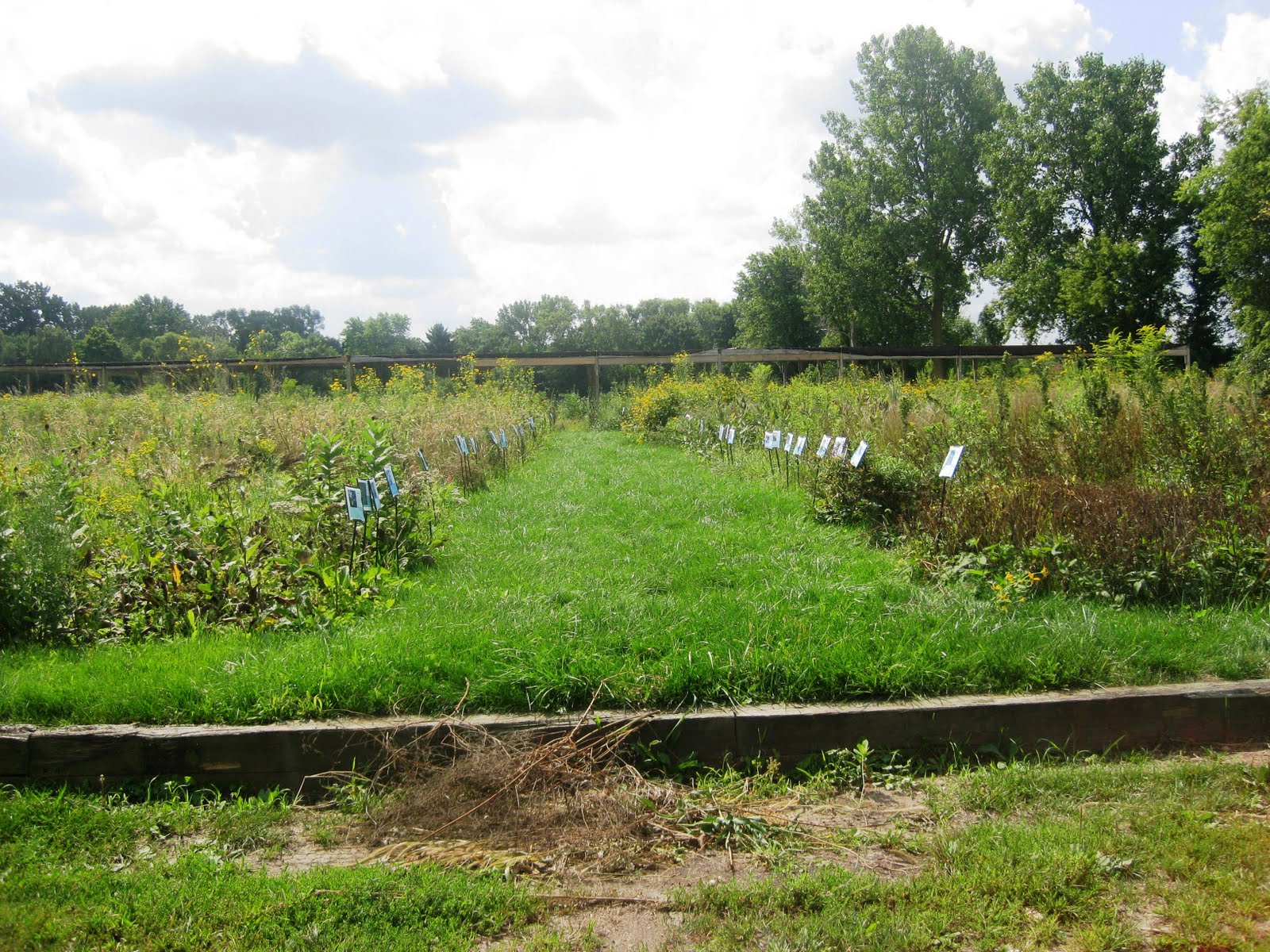
I also have 8 shade beds that I take care of, as well. They are right next to the sun beds, but are not raised. Here are the East shade beds. It's fun to work on these beds when its sweltering hot! The shade canopy is made to simulate the sun breaking through the upper canopy of a forest.


And here are the West shade beds! Recently I've been putting a lot of time in these beds because many of the seeds are ready to collect! The white signs indicate what was planted in each bed and where you can find them. Very helpful!


I ALSO have 3 extended beds that are full of little bluestem grass. It's funny - one of the forestry crew seasonals accidentally tilled all three of these beds under when he was tilling between the tree rows. He didn't realize that I was growing grass in these beds! So the grass is a little short, but doing ok after that incident lol.


And because I talk a lot about the forestry crew and their role in the nursery, here are a few pictures of the rows of baby trees. :)


There are a MILLION trees all over the nursery. These are just two shots near the planting beds that I work. It's fun to see them grow from teeny tiny to bigger trees that can be put in the preserves!

And to wrap up our audio tour of the nursery, here are some beautiful pictures of some flowers and plants that are headlining right now:


Sunflower

Yellow coneflower
Great blue lobelia and silky wild rye
Cardinal plant

Thanks for joining me on the nursery tour! I hope you enjoyed what I work with each week! Have a great day! :)